
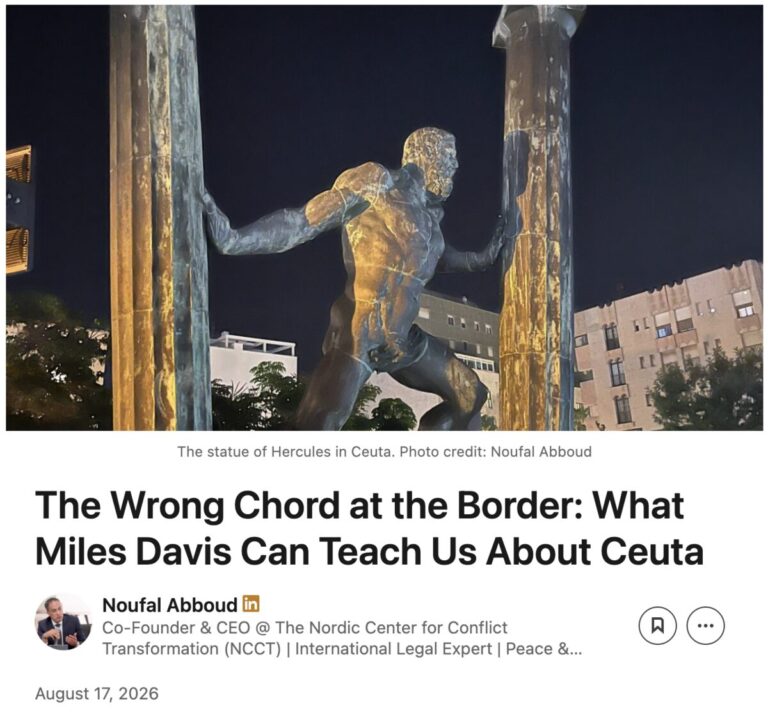
The story about Miles Davis, as told by Herbie Hancock, offers an inspiring perspective on what happened in Ceuta.
During one of Davis’s solos, Hancock said that he struck a wrong chord on the piano. It was so wrong that Hancock put his hands around his ears and stopped playing for a minute. For a musician of his calibre, the mistake was almost unbearable. Yet Davis did not recoil, or attempt to erase what had happened. Instead, he played a sequence of notes around Hancock’s wrong chord, and made it sound right. What had sounded irredeemably wrong suddenly belonged.
Hancock would later draw a profound lesson from the moment: Miles Davis did not hear the chord primarily as a mistake. He heard it as an event. Something had happened, and because it had happened, he took responsibility as a musician to find the notes that could make a wrong chord sound right.
So what does this have to do with the mass-crossing in Ceuta?
Those who attempted to cross into Ceuta can easily be heard, particularly from the other side of the sea, as a wrong chord: an irregular movement to be stopped, a border violation to be contained, a security problem to be managed. From the standpoint of sovereignty and border management, irregular crossings are unquestionably a legitimate concern. But calling the chord wrong tells us very little about why it was struck, or what must be played next.
By the time thousands of people are prepared to risk their lives and safety at a border, the crisis has already travelled a considerable distance before becoming visible to security institutions and political leaders. The border is where the problem becomes spectacular; it is rarely where the problem begins.
This is where the approach increasingly developed by the Nordic Center for Conflict Transformation (NCCT) becomes particularly relevant. We look at migration through an adaptation of Heinrich’s Triangle, originally developed in industrial safety and insurance. Its proposition is deceptively simple: the dramatic event at the top of the pyramid is rarely an isolated occurrence. Beneath it lies a much larger accumulation of less visible incidents, warning signs, and underlying conditions. Applied to migration, the crossing at Ceuta sits at the top; beneath it are school dropout, unemployment, economic exclusion, weakened trust in institutions, limited pathways to opportunity, and the gradual accumulation of frustration and hopelessness.
The implication is fundamental: if policy intervenes only when people reach the border, it is intervening at the narrowest, and most expensive, end of the triangle. Security can manage the event at the top. Conflict transformation requires us to work much further down the pyramid, where the conditions producing that event can still be changed. In Miles Davis’s terms, the task is not simply to condemn the wrong chord, but to understand what has happened as an event and find the notes that can make what follows different.
That distinction lies at the heart of NCCT’s approach of working upstream of crisis. It does not mean diminishing the importance of borders, law enforcement or legitimate security institutions. Quite the opposite. It means strengthening security by recognising where effective security actually begins. A border officer standing in Ceuta cannot reverse a young person’s school dropout years earlier. A surveillance system cannot create employment. A fence cannot restore trust between citizens and public institutions. And an emergency deployment cannot substitute for functioning channels through which grievances can be heard before desperation turns into movement.
This is why the notes played before the crisis matter.
Education is a note. Second Chance programs for school dropouts are a note. Youth employment is a note. Community resilience is a note. Responsive public administration is a note. Legal mobility pathways are a note. Stronger families, credible local institutions, civil society participation and economic opportunity are all notes. And security is a note too, an indispensable one, but it cannot be the entire composition.
The real question we should be asking about Ceuta is that instead of asking only how do we prevent people from crossing the border?, we should also ask: what accumulation of circumstances brought them to that border ready to risk their lives, and where could we have intervened earlier?

That is the significance of Heinrich’s Triangle for conflict transformation. The objective is not simply to become more efficient at managing the event at the summit. It is to move progressively downward, to identify vulnerabilities, strengthen institutions and expand opportunity while there is still space for opportunities rather than emergency response.
And here the Miles Davis story acquires its full meaning.
The people who reached Ceuta may represent the wrong chord. We need neither romanticise the crossing nor pretend that irregular migration presents no security challenge. But once that chord has sounded, simply declaring it wrong, or playing the security note louder, does not constitute a sustainable strategy.
We need to hear the notes and understand the composition that produced it, and begin playing the notes capable of changing what comes next.
Miles Davis transformed a mistake by changing the music around it. Perhaps migration policy requires something of the same intellectual imagination: not accepting the wrong chord as inevitable, but building the political, developmental and institutional foundations in which fewer young people will feel compelled to strike it in the first place.
That is ultimately what working upstream of crisis means: not waiting for the wrong chord at the top of the triangle, but changing the composition beneath it.