
The current crisis concerning Ceuta reveal a wider reality: migration cannot be understood solely as a question of border security. What becomes visible at the border is often the culmination of deeper socioeconomic, developmental and political pressures that have developed long before people embark on the journey towards Europe.
For Europe, although traditional security measures such as border controls, surveillance, deterrence, readmission agreements, and increased security cooperation are still necessary, they are increasingly on their own inadequate. They might to some degree help in managing migration flows, but they are unable to deal with the structural conditions which cause migration to begin with. It is for this reason that addressing those root causes by means of development, economic opportunity, and better living conditions represents the more sustainable solution.
The forces shaping migration are complex. Significant disparities in income, opportunity and living standards between Morocco and Europe continue to influence perceptions of mobility and future prospects. At the same time, unemployment, inflation and economic uncertainty have been compounded by global volatility and successive international crises, with many countries of what is considered as the Global South carrying a disproportionate share of their consequences.
Yet migration should not be reduced to poverty alone. Nor should migrants be reduced to statistics, security concerns or passive victims of circumstances. They are individuals with agency, aspirations, skills and diverse socioeconomic backgrounds. Many contemplating migration are educated, employed or professionally qualified, which can also contribute to the loss of valuable human capital in countries of origin. Their decisions are often shaped by the interaction between actual conditions and perceived possibilities: expectations of greater economic mobility, personal security, stability and opportunity elsewhere.
This distinction matters. If migration is driven not only by deprivation but also by a widening gap between aspirations and available opportunities, then border enforcement alone cannot provide a durable response. The policy question must also become how societies can expand credible economic, educational and civic pathways, strengthen confidence in institutions and build the resilience of communities before accumulated pressures translate into vulnerability, instability or irregular migration.
Recent developments surrounding Ceuta illustrate how quickly these underlying pressures can be intensified. Political debates in Spain over migration and regularisation, amplified by widespread and at times misleading information circulating through social media, appear to have contributed to perceptions that reaching Spanish territory could offer a rapid pathway to legal status. At the same time, inflammatory online narratives concerning Ceuta and Melilla, Spanish-administered territories on Morocco’s northern coast whose historical and political status remains a longstanding and sensitive issue in Morocco–Spain relations, have added another layer of political complexity and tension to an already difficult migration environment.
Ceuta should therefore be understood not only as a border-management challenge, but as an illustration of what happens when migration pressures, socioeconomic disparities, frustrated aspirations, information disorder and political sensitivities converge in the same space. Managing the immediate pressure requires security. Reducing the conditions that continually reproduce vulnerability requires something broader: investment in people, opportunities, institutions and resilient communities.
It is at this intersection between development, resilience and addressing the root causes that the concept of sustaining peace becomes particularly relevant.
Morocco Beyond Europe’s “Border Guard”
Morocco’s position makes this challenge particularly complex. It is simultaneously a country of origin, transit and, increasingly, destination, particularly for migrants from sub-Saharan Africa. Migration is therefore not simply a question of people passing through Morocco on their way to Europe. It also creates social, economic and institutional pressures within Moroccan communities themselves, particularly in areas situated along major migration routes.
Morocco has developed extensive cooperation with Spain and the European Union on migration management and has become an important partner in maintaining stability along the western Mediterranean route. Yet a sustainable partnership cannot be built on the expectation that Morocco should primarily function as Europe’s external “border guard.” If responsibility for managing migration is shared, responsibility for addressing the pressures surrounding migration must also be shared through development investment, economic opportunity, institutional cooperation and sustained support for affected communities.
This requires moving the policy conversation beyond the question of how borders are protected towards the equally important question of how communities are made more resilient.
It is precisely here that the concept of sustaining peace becomes relevant. Sustaining peace is not limited to responding to conflict once it occurs; it is also about strengthening societies before economic, social or political pressures translate into deeper vulnerability and instability. Applied to migration, this means investing in the environments from which migration decisions emerge and through which migration movements pass: expanding opportunities for young people, strengthening inclusive and responsive institutions, promoting social cohesion, supporting economic participation and increasing the capacity of local communities to manage change.
Seen from this perspective, development is not peripheral to migration or security policy. It is part of the infrastructure of prevention. The more resilient the communities exposed to economic, social and migratory pressures, the greater their capacity to absorb those pressures without allowing vulnerability to become instability.
From Analysis to Action: The NCCT Approach in Practice
This is the space in which the Nordic Center for Conflict Transformation (NCCT) has increasingly positioned its work: upstream of crisis, where development, governance, migration pressures and community resilience intersect.
Morocco’s southern regions provide an important testing ground for this approach. Situated along mobility routes connecting sub-Saharan Africa, North Africa and Europe, these communities experience economic, social and migratory pressures that are too often viewed primarily through a security lens. Yet strengthening border management without strengthening the communities behind those borders addresses only part of the challenge.
NCCT has therefore focused on the other side of the equation: building resilience before vulnerability becomes crisis. Our approach combines youth empowerment and employability, economic inclusion, educational reintegration through the school of 2nd chance and civic participation with stronger relationships between citizens and public institutions. Rather than treating these as separate development activities, we see them as interconnected components of sustaining peace: creating credible pathways for young people, strengthening confidence in institutions and increasing the capacity of communities to manage social and economic pressures.
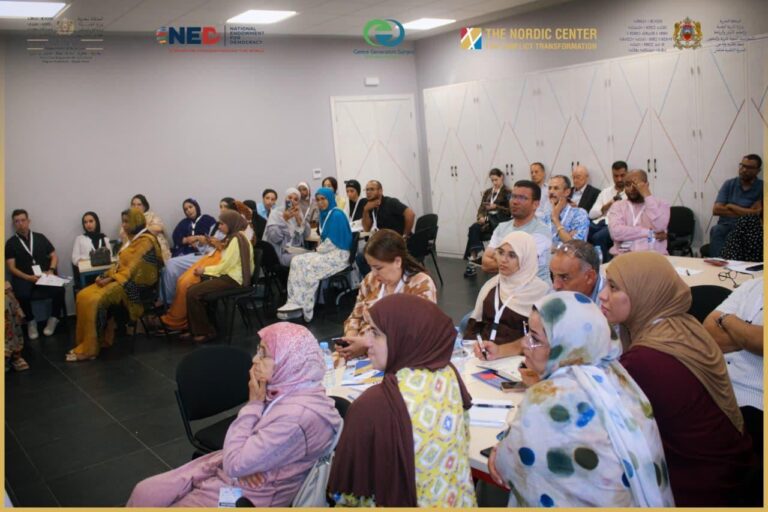
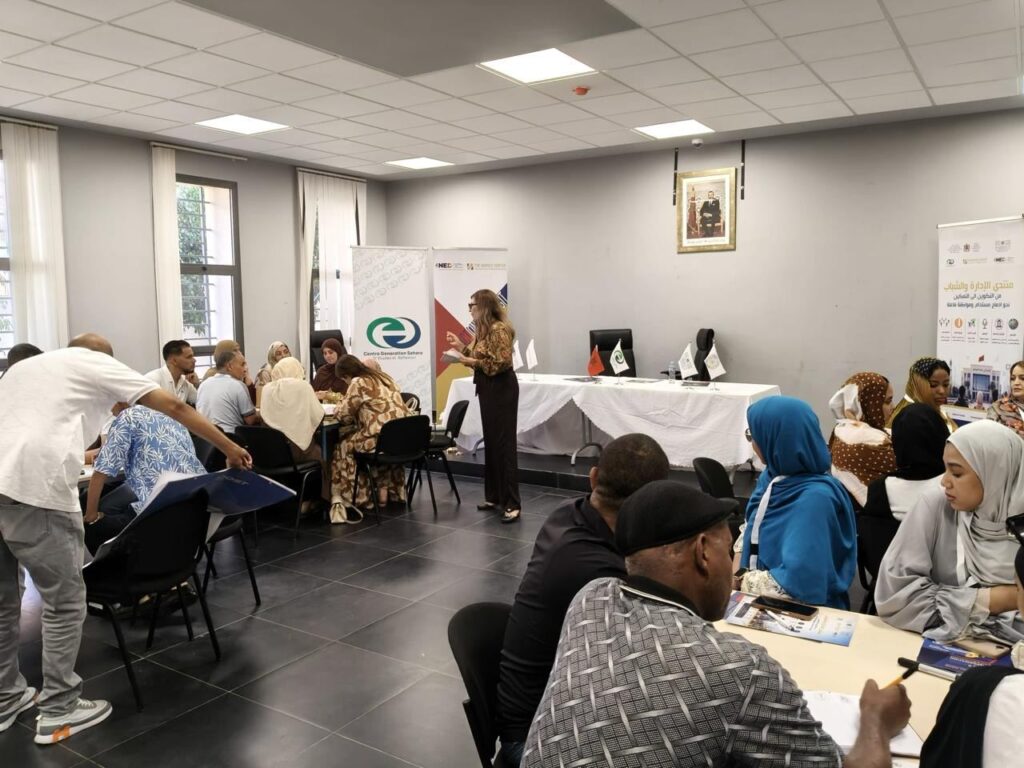
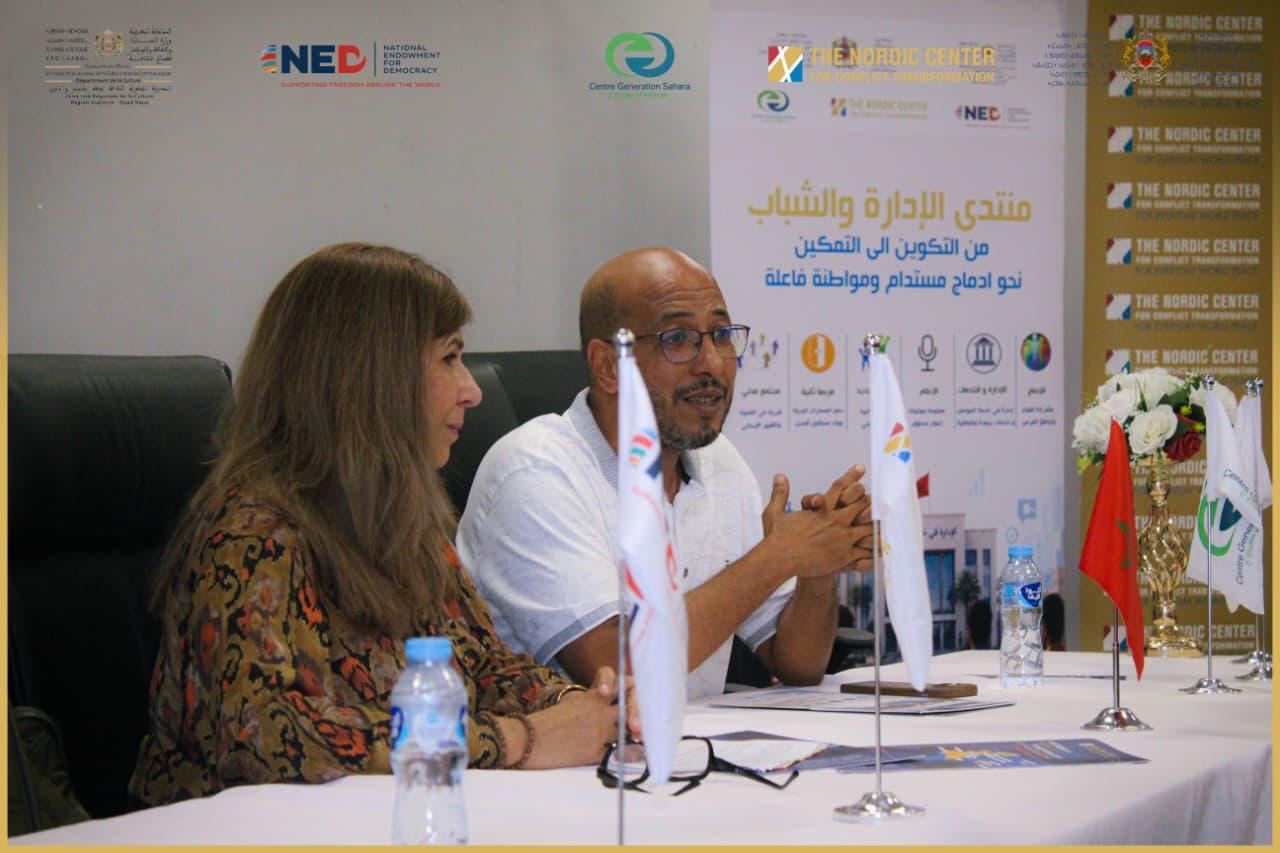
Our recent work in Tan-Tan illustrates this approach. NCCT brought together more than 140 young people, women, civil society organisations, public administrations, academics, media professionals and private-sector representatives from Morocco’s four southern regions through the Regional Youth and Public Administration Forum, “From Education to Empowerment: Towards Sustainable Inclusion and Active Citizenship.” The forum connected educational reintegration and employability with economic empowerment, civic participation and more responsive public governance, recognising that resilience depends not on a single intervention, but on the relationship between people, opportunity and institutions.
This relationship is central to NCCT’s approach. When young people see few credible economic, educational or civic pathways, vulnerability increases. When communities have stronger institutions, meaningful opportunities and mechanisms through which citizens can participate in decisions affecting their lives, their capacity to navigate economic and social pressure becomes considerably stronger.
The objective, therefore, is not to prevent mobility or suggest that development will bring migration to an end. It is to expand choice. Migration should increasingly be the result of opportunity and individual agency rather than constrained prospects, exclusion or the absence of credible alternatives.
NCCT works with communities before pressures become crises: strengthening local institutions, connecting young people with economic and educational opportunities, supporting civic participation, and creating spaces where citizens, public authorities, civil society and the private sector can jointly address local challenges. This is conflict transformation in its best dimension, not merely responding to instability, but strengthening the relationships, opportunities and institutions that make societies more resilient to it.
The Sustainable Development Goals provide an important framework for translating this approach into practice. By addressing inequality, expanding decent work and economic opportunity, strengthening inclusive and responsive institutions and supporting resilient communities, the SDGs can serve not simply as development targets but as practical instruments for prevention of violence and sustaining peace.
The Bottom Line
Ceuta should ultimately be read as more than a migration or border crisis. It is a reminder of what happens when economic disparities, constrained opportunities, youth aspirations, migration pressures, political sensitivities and rapidly circulating disinformation converge at the same frontier. By the time these pressures become visible at the border, many of the conditions behind them have already been developing elsewhere for years.
This is why security, while indispensable, cannot carry the burden alone. Border controls can manage movement, law-enforcement cooperation can respond to immediate crisis, and migration agreements can establish rules and responsibilities. But these instruments largely intervene once the crisis has already reached the frontier.
Security alone arrives too late in the chain.
A sustainable strategy must begin further upstream: with young people who need credible economic and educational chances; with communities that need the capacity to withstand social and economic challenges; and with institutions capable of responding to citizens, building trust and creating meaningful opportunities for participation. This is where development, conflict transformation and migration policy cease to be separate agendas but form part of a single nexus approach. Security alone arrives too late in the chain; only a joined-up approach can prevent crisis drivers from taking hold and reduce the pressures that fuel instability and displacement.