
August 2, 2026
Noufal Abboud
International law Scholar I Peace, Security and International Affairs Specialist
I still remember what a Swedish friend once told me. Before spending a summer in the Canary Islands, they had been warned never to go to “the other side” of the sea because Moroccans steal babies. It was an absurd claim, but one that revealed something far more profound than simple ignorance. It reflected a political culture in which fear of the “other” had long been cultivated and normalised. Spain was then emerging from the long shadow of Francisco Franco, who died in 1975. Although democracy had begun to take root, dismantling authoritarian institutions proved easier than dismantling the narratives that had sustained them.
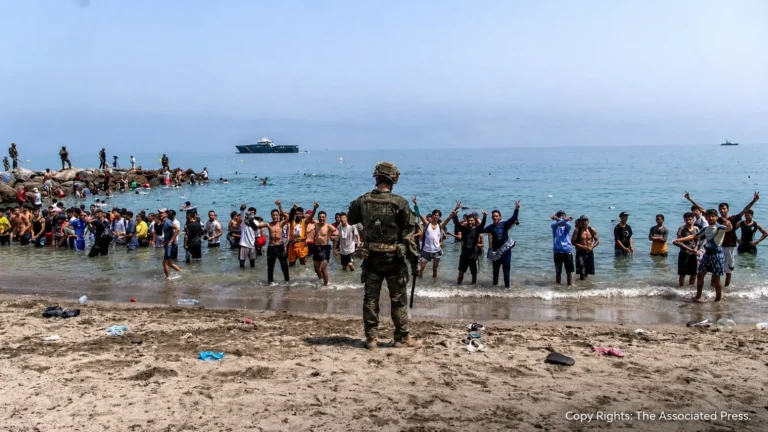
Among the most enduring was the construction of the cross-border neighbour as a permanent source of danger, a fear that outlived the dictatorship itself. Nearly five decades later, one might have expected Europe to have moved decisively beyond such reflexes. Yet the reaction to the recent events in Ceuta suggests that this imaginary remains remarkably resilient. Much of the public discourse has portrayed Africans, and Moroccans in particular, not as human beings driven by complex political, economic, or humanitarian realities, but as a faceless, overwhelming force advancing like a zombie horde.
This is the real Pandora’s box that has been opened: not migration itself, but the resurrection of a dehumanising narrative that reduces individuals to a collective threat. Once people cease to be seen as human beings with names, histories, and aspirations, fear becomes easier to manufacture than understanding, and political theatre begins to replace serious policy.
The Borders We Never Decolonised
The Canary Islands, Ceuta, and Melilla remain enduring reminders that the decolonisation of Africa was never fully completed. They expose the unresolved contradictions surrounding the 1960 wave of independence and the principle that newly independent African states would inherit the colonial borders existing at the time of independence (uti possidetis juris).
For African leaders, such as in my conversation with a former head of an African State, this principle was never regarded as an ideal. It was a pragmatic compromise designed to prevent newly independent states from descending into endless territorial disputes. Over time, however, many former colonial powers came to treat these inherited borders not as a temporary political settlement but as an untouchable doctrine. What began as a practical necessity gradually acquired the status of political orthodoxy.
The consequences remain visible today. Artificial colonial frontiers fragmented communities, divided families, and left behind territorial anomalies that continue to generate political tension. Ceuta and Melilla are among the clearest examples: European enclaves on the African continent that have become symbols not only of colonial continuity but also of the unresolved legacy of Europe’s presence in Africa.
For decades, Morocco has sought to address these realities through dialogue rather than confrontation. Practical arrangements were established that allowed residents of neighbouring Moroccan provinces to cross into Ceuta for work, trade, and family life without cumbersome visa requirements. These local understandings recognised a simple truth: the border separated communities that had long been socially and economically interconnected. As the European Union increasingly framed Ceuta and Melilla primarily through the lens of border security, this pragmatic approach gradually gave way to securitisation.
Visa requirements, reinforced controls, and a fortress mentality transformed what had once been a permeable local frontier into one of Europe’s most heavily policed external borders. In the process, communities divided by colonial-era boundaries found themselves further separated, not by geography, but by policies that increasingly privileged security over historical reality and human connection. Whether one agrees with Morocco’s sovereignty claim or with Spain’s position, it is difficult to deny that Ceuta and Melilla are not merely border crossings. They are unresolved historical questions inherited from the colonial era. Treating them solely as migration or security issues risks obscuring the deeper historical and political context that continues to shape them today.
History Demands Humility
What does Sweden have to do with it? Quite a lot, actually. The Canary Islands are among Sweden’s favourite holiday destinations. Yet few Swedes would describe the archipelago as Sweden’s “backyard” or argue that Swedish interests should shape the way Europe governs the lives of those on the opposite shore. The language changes, however, when discussions turn to migration, borders, and North Africa. Then, the vocabulary of democracy, human rights, and European security often acquires a noticeably more prescriptive tone. Sweden’s contemporary commitment to democracy, human rights, and the rule of law is both genuine and commendable. But no European nation, including Sweden, arrived at its present position untouched by history.
Like many of its neighbours, Sweden expanded through wars of conquest, military campaigns, and territorial ambition before evolving into the democratic state it is today. Spain’s history follows a similar trajectory, with one important distinction: it continues to administer two European enclaves on African soil, Ceuta and Melilla, whose status remains contested by Morocco. This is not an argument for historical guilt, nor an attempt to diminish the democratic achievements of either country. It is a reminder that history should cultivate humility rather than selective moral superiority.
Nations that have themselves undergone profound historical transformations should perhaps be the first to recognise that complex disputes rarely lend themselves to simplistic narratives of virtue and vice. If democracy, international law, sovereignty, and human rights are to retain their moral authority, they must be applied consistently rather than selectively. Their credibility depends not on who invokes them, but on whether they are upheld with the same conviction when they challenge our own assumptions and interests as when they challenge those of others. Only then can we move beyond moral exceptionalism and engage in the kind of honest, intellectually rigorous debate that complex issues such as Ceuta, migration, and Europe’s relationship with Africa genuinely require.
Fences and Frontiers
Even if one chooses to frame the discussion primarily through the lens of democracy, uncomfortable questions remain. How should we understand the rise of exclusionary politics across Europe, including in Sweden, where anti-immigration rhetoric and policies have increasingly entered the political mainstream?
In several countries, parties traditionally associated with liberal and democratic values have, to varying degrees, adopted or accommodated restrictive agendas once considered the preserve of the political fringe. Democracy, after all, is not merely the rule of the majority; it is also measured by how it safeguards the dignity and equal rights of minorities. When democratic legitimacy is invoked to justify discriminatory policies, it is reasonable to ask whether democracy is fulfilling its highest purpose or merely reflecting the anxieties of the moment.
The same principle of consistency applies to human rights. Article 13(2) of the Universal Declaration of Human Rights affirms that “Everyone has the right to leave any country, including his own, and to return to his country.” This provision does not create an unrestricted right to enter another state, nor does it eliminate states’ legitimate interest in managing their borders. It does, however, remind us that migration is fundamentally a human phenomenon before it becomes a security issue.
Those who argue that Morocco should simply prevent people from reaching Ceuta or attempting to cross into Europe, should remember that European governments themselves have confronted comparable dilemma with their own nationals. Over the past two decades, these governments have invested considerable effort in preventing their own citizens from travelling to conflict zones in Iraq and Syria to join terrorist organisations, but they couldn’t retain them from doing so. Those individuals were overwhelmingly European nationals, born and raised in Europe. At the Nordic Center for Conflict Transformation (NCCT), our interviews and research with individuals who returned from conflict zones repeatedly surfaced a common thread: many described profound experiences of alienation, exclusion, discrimination, and fractured belonging. While none of these grievances can excuse violence or terrorism, they demonstrate that mobility, identity, and security are rarely reducible to policing alone.
The lesson is broader than either migration or counterterrorism. Durable security cannot be achieved solely through fences, surveillance, or border enforcement. It also depends on addressing the political, social, and economic conditions that shape human behaviour. Reducing complex human realities to simplistic narratives of security may offer short-term political comfort, but it rarely provides lasting solutions.
What to do next?
Looking ahead, we have a choice. We can continue refining policies that have repeatedly struggled to address the underlying causes of border crises, or we can begin transforming the root causes, the narratives and mentalities that shape them. While effective policies remain essential, experience has shown that lasting solutions cannot be built on enforcement alone. They require trust, dialogue, and the willingness to question deeply rooted assumptions about one another. This conversation should not be confined to those who already agree. It is precisely with those who hold different perspectives that genuine progress becomes possible.
Democracies are strengthened not by the absence of disagreement, but by the capacity to engage disagreement with intellectual honesty, mutual respect, and an openness to challenge one’s own certainties.
It is in this spirit that NCCT, founded in Sweden and operating extensively in Morocco, seeks to contribute. Positioned between Europe and North Africa, and grounded in research, dialogue, and practical experience, NCCT provides a platform where difficult conversations can take place without reducing complex realities to simplistic binaries. If we are serious about building a more secure and just relationship between Europe and Africa, the first frontier we must cross is not the one on the map, but the one in our minds.